
Drawing My Way Home: How I Found my Ikigai Through Art – Rima Ghanem.

This blog provides a deeply personal and reflective journey on how Rima Ghanem found her ikigai (a Japanese concept that represents one's reason for being or purpose in life). She shares with us key moments in her life, offering insights into her professional evolution and emotional growth and ends with advice to others on how to find their ikigai.
Personal Background
Can you share a bit about your professional background? I studied interior design and worked as an interior designer for a few years. Over time, I naturally transitioned into teaching drawing. Little did I know, this shift would lead me toward discovering my true purpose.
What did you initially expect from your career, and how did that align (or not) with your sense of purpose?
When I chose interior design, it wasn’t really about designing spaces—it was about the opportunity to draw. My decision was a pretext for creativity, a way to express myself through design. Over time, this path became clearer as my true passion for drawing emerged.

Great Expectations 1999-2019. Was there a time when you felt your job title or career didn’t fully define who you were?
During my final diploma project, I chose an unorthodox theme that was more focused on personal expression than the usual evaluation criteria. I was guided by my vision and the need to fully express myself. That was the moment I knew I was on the right track.
The Search for Meaning
When did you first start feeling the need to find meaning or purpose beyond your job?
I realized I needed to become the person I envisioned, so I began experimenting with materials and textures to express my creativity. It was a process—a journey of experimentation that led me to a state of flow, where I could truly represent my ideas artistically.
How did you know when you had found something that truly resonated with you?
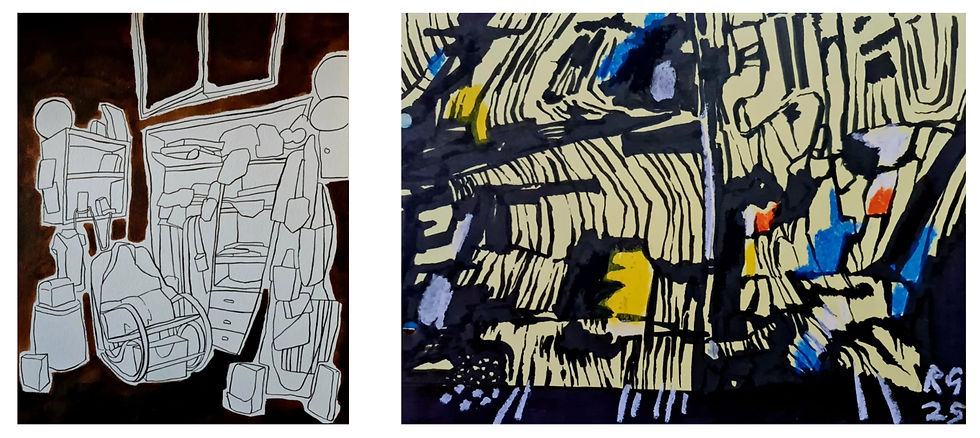
Drawing and experimenting with fabric and materials became an integral part of who I am. It allows me to trace my life's journey. Each illustration reflects a specific time in my life, and it helps me understand what I was going through at that moment. Art has become my mirror.
Did your ikigai influence how you approached your main career or job? If so, how?
My approach to teaching and creating art is rooted in the same passion. With my students, we brainstorm, problem-solve, and approach projects creatively. Just like with my own work, I encourage them to stay true to their artistic vision, ensuring their concepts are executed with integrity and passion.

Integrating Ikigai into Your Life
Have you made any changes to your lifestyle, habits, or priorities to align with your ikigai?
I consciously stopped certain activities to make more space for observation and drawing inspiration from everyday life. This shift has made me feel energized and inspired, as I now see beauty and creativity in everything around me.
How has finding your ikigai affected your relationships with others?
My artistic style is unique, and it isn’t always understood by others. Some can’t follow me to the places where my creativity takes me. But I’ve chosen not to compromise my vision for the sake of being mainstream. Whether through drawing or teaching, I remain loyal to my artistic integrity and refuse to dilute my message to please others.

Pandora's Box 1999- 2024. Part 1 Do you feel that your ikigai has helped you become more resilient or fulfilled, even during challenging times?
I stopped trying to fit in with others’ expectations. Instead, I became true to myself, my art, and my students. Living authentically has given me a sense of peace, resilience, and fulfillment, even during difficult times.

Advice for Others
What advice would you give to someone who feels stuck in their career and is searching for meaning beyond their job title?
You know you’re on the right path when your work feels effortless. When you’re doing something you love and are good at, everything falls into place naturally. There’s no need to fight against it. Work should flow from a place of comfort and passion, and from there, you can expand and grow.
11. How can someone start exploring their passions or interests without making a drastic career change?
Ask yourself: Are you good at it, and do you love it? That’s the first step. When did I last feel ‘in flow’? is another way to assess what come sto you naturally.
Finding small ways to integrate your passions into your daily life or current work can spark the inspiration you need.
How can individuals overcome the fear of failure or judgment when pursuing their ikigai?
When your work is public, it needs to be credible. You have a responsibility to develop your craft and become skilled at what you do. If your work resonates with you, it will resonate with others too. Confidence comes from mastery, and if it makes sense to you, it will ultimately make sense to those who experience it.
Reflection and Growth
Looking back, how has finding your ikigai changed your perspective on work, life, and happiness?
Life offers us gifts; it’s up to us to nurture and develop them. Finding my ikigai has been a blessing. It’s a journey that’s helped me grow emotionally, wisely, and with love. There’s nothing harmful about doing what you love and helping others do the same.
If you could go back in time, what would you tell yourself at the start of your journey?
I would tell myself that what I am seeking is also seeking me. Don’t be afraid.
How do you define success now, compared to before you found your ikigai?
Success, to me, is about believing in what I do and holding nothing back. It’s about being authentic, fully expressing my vision, and remaining true to my craft.

Key Takeaways:
Authenticity and Self-Expression: staying true to one’s personal vision and embracing artistic expression as a form of self-discovery. This commitment to authenticity is central to their ikigai.
The Journey of Discovery: Ikigai is not a sudden realization but a continuous process of self-exploration, experimentation, and reflection.
Passion and Fulfillment: Aligning one’s career with passion can lead to profound fulfillment, as evidenced by Rima’s shift from interior design to teaching and drawing.
Resilience Through Authenticity: By embracing ikigai, the author finds strength and resilience in the face of challenges, living authentically and letting go of societal expectations.
Practical Advice: Rima encourages others to find what they love and excel at, emphasising that work should feel effortless when aligned with one’s true purpose.

Final Thoughts
Discovering your ikigai is not an immediate realisation but a process of trial, self-reflection, and creative exploration. It’s about finding the intersection of passion, mission, profession, and vocation that allows you to live with purpose and authenticity. For me, ikigai has been transformative—it’s helped me stay grounded, embrace my unique artistic path, and foster deeper fulfilment in my life and work.
Comments